
How to Pick the Right Pair of Running Shoes
- Category: General
- Posted On:
- Written By: Fox Valley Orthopedics

There is a staggering variety of athletic shoes on the market today. From carbon-plated “super shoes” to maximalist cushioning, the options are endless. While variety is great, it can make choosing the right pair a challenge.
Selecting the right pair of shoes is a critical investment in both your athletic performance and your long-term orthopedic health. Beyond simple discomfort, an ill-fitting shoe can exacerbate or even trigger chronic foot conditions such as bunions, hammertoes, and plantar fasciitis. To help you navigate the complexities and many choices of modern footwear technology, we’ve updated our guide to ensure your next pair provides the precise support your feet require.
STEP 1: Determine Your “Runner’s Profile”
The first step to finding the right shoe is to consider the terrain you’ll be training on, intensity of your training, and your unique support needs. Most runner now benefit from a “shoe rotation” rather than a single do-it-all pair.
By Terrain
- Road Shoes: Optimized for pavement and treadmills. They prioritize cushioning and flexibility to handle repetitive impact on hard, even surfaces.
- Trail Shoes: Designed for off-road adventures. They feature ‘lugs’ for gripping mud or loose dirt and a ‘rock plate’ to protect your soles from sharp roots and stones.
- Track Spikes: Ultra-lightweight shoes with metal pins, strictly for competitive track use. They offer zero cushioning and are built for maximum speed and traction.
By Training Goal
- Daily Trainers: The “workhorse” of your closet. These are durable, balanced shoes designed for most of your weekly mileage and recovery runs.
- Tempo/Speed Shoes: Lighter and firmer than daily trainers. These are designed to feel “snappy” and help you maintain a faster pace during interval workouts.
- Race Day Shoes: Modern high-performance shoes that often include a carbon-fiber plate and specialized foam. These are designed to maximize energy return for marathons and other long-distance races.
By Support & Gait
- Neutral Shoes: Ideal for runners with a natural stride or high arches (under-pronation or supination). They focus on uniform cushioning without added structural support.
- Stability Shoes: Designed for those whose feet roll inward (over-pronation). These feature firmer foam on the inner side of the shoe to nudge the foot back into a neutral alignment.
- Motion Control: Built for severe over-pronation or very flat feet. These are more rigid and structured to limit excessive foot movement that could lead to injury.
Your body type also matters. Running puts three to five times your body weight on your joints with every stride. Taller or heavier runners often benefit from “maximalist” shoes with more foam to absorb that impact, while lighter frames can handle a more “minimal” or responsive feel.
STEP 2: Know Your Arch & Gait
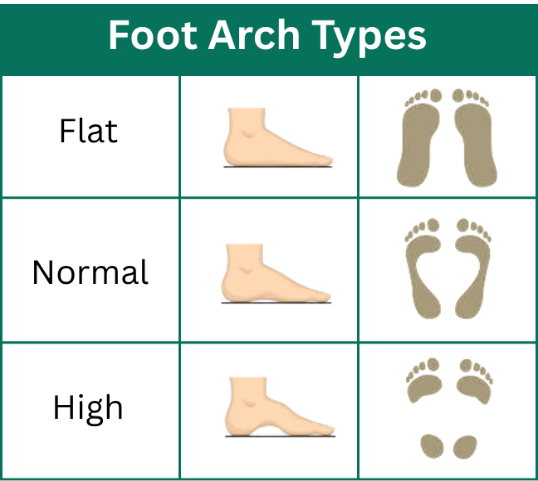 The way your foot strikes the ground determines the support you need.
- High Arches: Often lead to under-pronation, where the foot doesn’t roll inward enough. A “neutral” cushioned shoe may feel best.
- Flat Feet: Often lead to over-pronation, where the foot rolls inward excessively. You may need “stability” or “motion control” shoe to prevent strain on the lower leg and knees.
Many specialty shops offer digital gait analysis. A process in which they will have you walk or briefly run on a treadmill to see exactly how your foot lands. If you have a history of shin splints or tendonitis, this step is especially important.
STEP 3: Size Up (Literally)
Feet change over time, and they also swell during physical activity, which is why most runners find that their ideal running shoe is a half-size to a full size larger than their casual footwear. When you’re being fitted, ensure there is about a thumbnail’s width of space in the toe box; your toes should never feel cramped or touch the front of the shoe when you walk. To ensure an accurate fit, always have your feet measure any time you are looking for a new pair; don’t assume your size remains the same year-to-year (it doesn’t). Furthermore, because sizing varies significantly between manufacturers, you should always prioritize the actual feel and security of the shoe over the specific number on the box.
STEP 4: The 360° Comfort Test
Don’t just check the length. Consider the width and the “lockdown” of the heel. Your foot should sit securely on the platform without sliding side to side. If you feel any pinching or rubbing at the 360° mark, that small irritation has a high chance of becoming a blister after only a few miles.
 STEP 5: Shop Late (and Bring Your Socks!)
Because feet swell throughout the day, it’s a good idea to shop for shoes in the late afternoon or after a workout. This ensures the shoes fit when your feet are at their largest. Also, bring the socks you plan to run or train in. A thick padded sock versus a thin compression sock can completely change how a shoe fits.
STEP 6: Test Drive Several Pairs
Technology has changed the “feel” of shoes. Some foams feel bouncy and have great energy return, while others feel plush, offering maximum cushion. To find which feels best, take your time and try on at least three different brands. Many specialty stores will let you take a quick jog on the sidewalk or a treadmill to feel the shoes in action.
STEP 7: Choose Function over Fashion
We know. It’s tempting to pick the neon pair that matches your favorite gear, but function must come before fashion. Many designer sneakers are “hourglass” shaped, which doesn’t match the natural C-shape or straight shape of the human foot. Choose the shoes that support your orthopedic health first. Your joints will thank you miles down the road.
We’re Here to Help
If you have questions about your foot structure or need specialized orthopedic support, our team is here to help. Reach out to us at (855) 386-7846 to ensure your orthopedic health is as strong as your training plan.